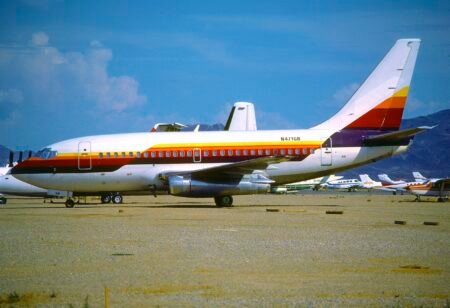


Delta Air Lines‘ Decision to Retire Boeing 767-300ER Fleet
Delta Air Lines has confirmed its plan to retire its Boeing 767-300ER aircraft by 2030, with international long-haul services ending by 2028. This decision signifies a significant shift in Delta’s strategy concerning their widebody fleet. The focus will be on understanding the rationale behind this move, what part of the fleet will remain active, what new aircraft have been ordered, and the potential alternatives Delta might explore.
The Legacy of the Boeing 767
The Boeing 767 has been integral to Delta for decades, notably on international and transcontinental routes. With the advancing age of these aircraft, around 30 years, Delta’s decision to retire them mirrors broader trends in the aviation industry. We will delve into various pressures, including technical, financial, and operational, consider the alternatives chosen by Delta so far, and explore what might follow.
History and Details of Delta’s 767 Fleet
Delta began flying the Boeing 767-200 in the early 1980s, later adding the 767-300 and the extended-range 767-300ER in the late ’80s and early ’90s. Though successful, the 767-300ERs are now aging, prompting their upcoming retirement. Delta continues to operate its younger 767-400ERs, which started service in 2000.
As stated in the Q4 2023 earnings call, Delta’s President, Glen Hauenstein, mentioned that the 767-300ER fleet would be phased out of international service by 2028 and retired by 2030. Presently, Delta operates 37 767-300ERs. This decision is due to increased maintenance costs, declining efficiency, and evolving passenger expectations.
Factors Leading to the Retirement
The decision is driven by several factors, including fuel efficiency, regulatory pressures, and passenger expectations. New aircraft like the Airbus A350 and A330neo offer substantially better fuel efficiency and lower emissions. Maintenance costs for the older 767s are rising, and retrofitting to meet modern passenger expectations is impractical for older models.
Replacement Aircraft for the 767-300ERs
Delta has made strategic acquisitions of new aircraft. In January 2024, Delta ordered 20 Airbus A350-1000s, plus 38 A350-900s, and is deploying Airbus A330-900neo aircraft on long-haul routes. These models offer higher fuel efficiency and enhanced passenger experience compared to the retiring 767-300ERs.
Potential Aircraft Alternatives
- Boeing 787 family: Offers modern, fuel-efficient designs suitable for replacing the capacity of the 767-300ER.
- More A330-900neo aircraft: Already part of Delta’s fleet, providing operational efficiency and fleet commonality.
- Increased A350-1000s fleet: Useful on high-demand routes.
- Potential future aircraft innovations: Possible consideration for future expansion.
Delta’s new orders indicate a substantial modernization of their fleet, though the A350-1000 isn’t a direct one-for-one replacement for the 767-300ER. Delta’s network planners will balance various factors like capacity, frequency, and costs in implementing these changes.
Implications and Future Considerations
The transition away from the 767-300ER will affect Delta’s operations and environmental impact. Newer models will reduce costs, improve reliability, and align with environmental goals. The competitiveness of Delta’s long-haul services will benefit from enhanced passenger experience, crucial in gaining route rights and slots.
Future observations will include the expansion of Delta’s A350-1000 fleet, introduction of potential Boeing 787 models, and emerging aircraft technologies. Additionally, external factors like fuel prices and regulatory changes will influence Delta’s fleet decisions.
In conclusion, Delta’s retirement plan for the 767-300ER emphasizes both necessity due to the aircraft’s age and opportunity for modernization. As Delta transitions to more efficient aircraft, passengers can expect more comfort and innovation on long-haul routes.
| Specification | Boeing 767-300ER | Boeing 767-400ER | Airbus A350-900 | Airbus A350-1000 |
|---|---|---|---|---|
| Typical 3-class passenger capacity | ~218 pax | ~245 pax | ~314-325 pax | ~375-400 pax |
| Maximum Take-Off Weight (MTOW) | ~412,000 lb (~186,880 kg) | ~450,000 lb (~204,120 kg) | ~624,000-626,000 lb (~283,000-284,000 kg) | ~709,900-710,000 lb (~322,000 kg) |