
Global Aviation Growth in 2025
The global aviation industry has shown a strong recovery from the COVID-19 pandemic’s impact. The International Air Transport Association (IATA) reported a 10.4% increase in global air passenger demand in 2024 compared to 2023, with traffic exceeding pre-pandemic levels by 3.8%. Concurrently, Airports Council International (ACI) noted that 2023 global passenger traffic reached 8.7 billion, a 30.6% rise from 2022, nearing 95% of pre-pandemic volumes.
Top 10 Busiest International Airports, September 2025
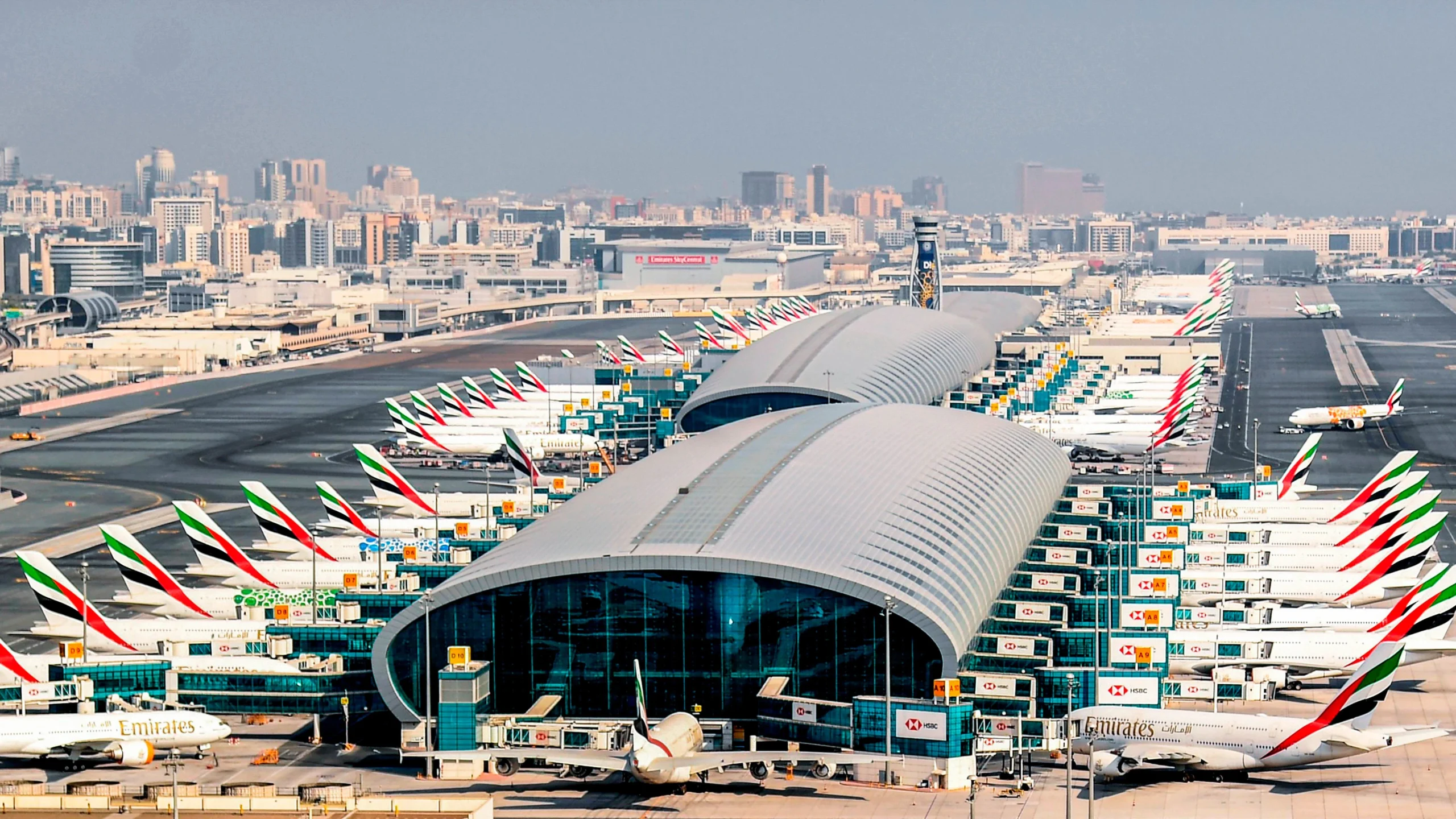
As per a report by OAG, Dubai International Airport (DXB) remains the top global hub with over 5.1 million seats, leveraging its strategic positioning as a major link between Europe, Asia, and the Americas. London Heathrow (LHR) and Amsterdam Airport (AMS) are prominent European gateways, offering 4.1 million and 3.66 million seats, respectively.
- Dubai International Airport (DXB): Offers luxury amenities and connects key global destinations.
- London Heathrow (LHR): Handles over 4.1 million seats with extensive traveler facilities.
- Amsterdam Airport (AMS): Very efficient for international connections with 3.66 million seats.
Growth Trends in Major Airports
Istanbul Airport (IST) rose to the fourth position with a 5% capacity increase, becoming a significant transit hub. Meanwhile, Hong Kong International (HKG) saw an 8% rise in capacity, indicating Asia-Pacific’s recovery. Conversely, Seoul Incheon (ICN) faced a 2% decline, potential due to operational constraints.
Dubai International Maintains Leadership
Dubai International Airport continues expanding, growing 4% from September 2024, demonstrating strong Middle Eastern passenger demand. Its strategic location supports its role as a global transit point.
Istanbul Airport’s Rapid Expansion
With a seating capacity increase of 5%, Istanbul Airport (IST) has moved up the ranks, supported by Turkish Airlines’ international route expansion, consolidating the airport as a connecting hub between Europe and Asia.
European Airports’ Stability
London Heathrow (LHR) remains steady, while Amsterdam Schiphol (AMS) grows by 3%. Paris Charles de Gaulle (CDG) and Frankfurt International (FRA) also stay in the top 10, underscoring Europe’s connectivity strength.
| Feature | Paris Charles de Gaulle (CDG) | Frankfurt Airport (FRA) | London Heathrow (LHR) | Amsterdam Schiphol (AMS) |
|---|---|---|---|---|
| Location | Roissy-en-France, near Paris, France | Frankfurt, Hesse, Germany | London, United Kingdom | Haarlemmermeer, near Amsterdam, Netherlands |
| Major Hub Airline | Air France (AF) | Lufthansa (LH) | British Airways (BA) | KLM Royal Dutch Airlines (KL) |
| Runways | 4 | 4 | 2 | 6 |
Asia-Pacific Developments
Hong Kong International (HKG) leads in growth within the top 10. Meanwhile, Seoul Incheon (ICN) observes a slight decline. Singapore Changi (SIN) provides a stable seat offering, indicating ongoing demand.
Middle Eastern Hubs’ Influence
Doha and Dubai illustrate the region’s dominant role in global air travel, serving as vital international transit points. Istanbul’s rapid growth further amplifies the Middle East’s aviation prominence.
| Rank | Airport Code | Airport Name | Seats (Total) | Same Month 2024 Ranking |
|---|---|---|---|---|
| 1 | DXB | Dubai International | 5,103,110 | 1 |
| 2 | LHR | London Heathrow | 4,157,631 | 2 |
| 3 | AMS | Amsterdam | 3,660,399 | 3 |
| 4 | IST | Istanbul Airport | 3,534,358 | 7 |
| 5 | ICN | Seoul Incheon International Apt | 3,457,303 | 4 |
| 6 | CDG | Paris Charles de Gaulle | 3,419,739 | 5 |
| 7 | SIN | Singapore Changi | 3,401,120 | 6 |
| 8 | FRA | Frankfurt International | 3,341,152 | 8 |
| 9 | HKG | Hong Kong International | 3,107,473 | 9 |
| 10 | DOH | Doha (QA) | 2,726,623 | 10 |
Conclusion
Dubai continues to lead global aviation through strategic expansion and connectivity. Simultaneously, Istanbul’s growth hints at rising competitive opportunities for transit hubs. European airports maintain steady performance, while Asia-Pacific displays mixed recovery.