

The F-15C/D Eagle: A Storied Fighter’s Transition
The McDonnell Douglas F-15C/D Eagle has long been a cornerstone of the United States Air Force (USAF), serving as its premier air superiority fighter for over four decades. As of early 2025, the active-duty USAF retired its last operational F-15C/D squadrons due to the aircraft’s age, escalating maintenance costs, and the availability of advanced platforms like the F-15EX Eagle II and F-35.
The transition was marked by the deactivation of instructor pilot squadrons, formally ending the era of regular Air Force Eagle operations. Nevertheless, the F-15C/D remains active within the Air National Guard, a crucial element of the USAF’s Total Force, for roles including aerospace control and intercept missions.
The Origins of the F-15C/D Eagle
In the late 1960s, the US Air Force sought to overcome the limitations of aircraft like the F-4 Phantom II, which underperformed in dogfights during the Vietnam War. The emergence of the Soviet MiG-25 “Foxbat” necessitated an air superiority fighter designed for dominance.
The F-15A debuted in 1976, quickly illustrating its superiority. By 1979, the improved F-15C/D models were introduced, featuring enhanced fuel capacity, increased maximum takeoff weight, and advanced avionics, making them suited for high-threat intercepts.
Current Operations of the F-15C/D Eagle
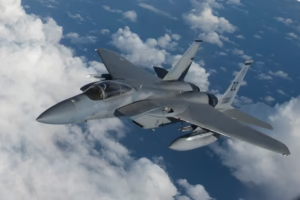
- 104th Fighter Wing (Barnes ANGB, Massachusetts): Safeguarding the northeastern US, including corridors over Washington D.C. and New York.
- 142nd Fighter Wing (Portland ANGB, Oregon): Defending the Pacific Northwest with rapid intercept capability.
- 144th Fighter Wing (Fresno ANGB, California): Responding to threats along the West Coast and Alaskan patrols.
- 159th Fighter Wing (NAS JRB New Orleans, Louisiana): Known as the “Bayou Militia,” securing the Gulf Coast.
- 173rd Fighter Wing (Kingsley Field, Oregon): Last formal training center for F-15C/D pilots.
Maintaining the F-15C/D Eagle’s Relevance
Ensuring a 40-year-old fighter remains combat-ready involves significant investment in upgrades:
- Radar Upgrades: Installation of AN/APG-63(V)3 AESA radar for enhanced detection and tracking.
- Avionics Modernization: Digital multifunction displays and Link 16 datalink capability enhance pilot situational awareness.
- Weapons Integration: Compatibility with AIM-120D AMRAAM and AIM-9X Sidewinder missiles.
- Structural Work: Essential refurbishments to wings and fuselage to maintain airworthiness.
Comparing the F-15C/D to Other USAF Aircraft
The F-15C/D Eagle holds the distinction of being the oldest dedicated fighter within the USAF’s Total Force. However, it shares this longevity with other legacy aircraft:
| Aircraft | Entered Service | Current Role | Status in 2025 |
|---|---|---|---|
| B-52H Stratofortress | 1961 | Strategic bomber | Flying, modernized |
| KC-135R Stratotanker | 1957 | Aerial refueling | Flying, multiple upgrades |
| A-10C Thunderbolt II | 1976 | Close air support | Flying, still debated |
| F-16C/D Fighting Falcon | 1984 | Multirole fighter | Flying, heavily upgraded |
| F-15C/D Eagle | 1976 | Air superiority fighter | Retired/ANG phaseout |
The Future of the F-15C/D Eagle
The Air National Guard expects to retire its final F-15C/D Eagles by 2026, transitioning to the more advanced F-15EX Eagle II. While this marks the end for the C/D models, their legacy as steadfast defenders of American airspace will be enduring, bridging the past and present in USAF history.