
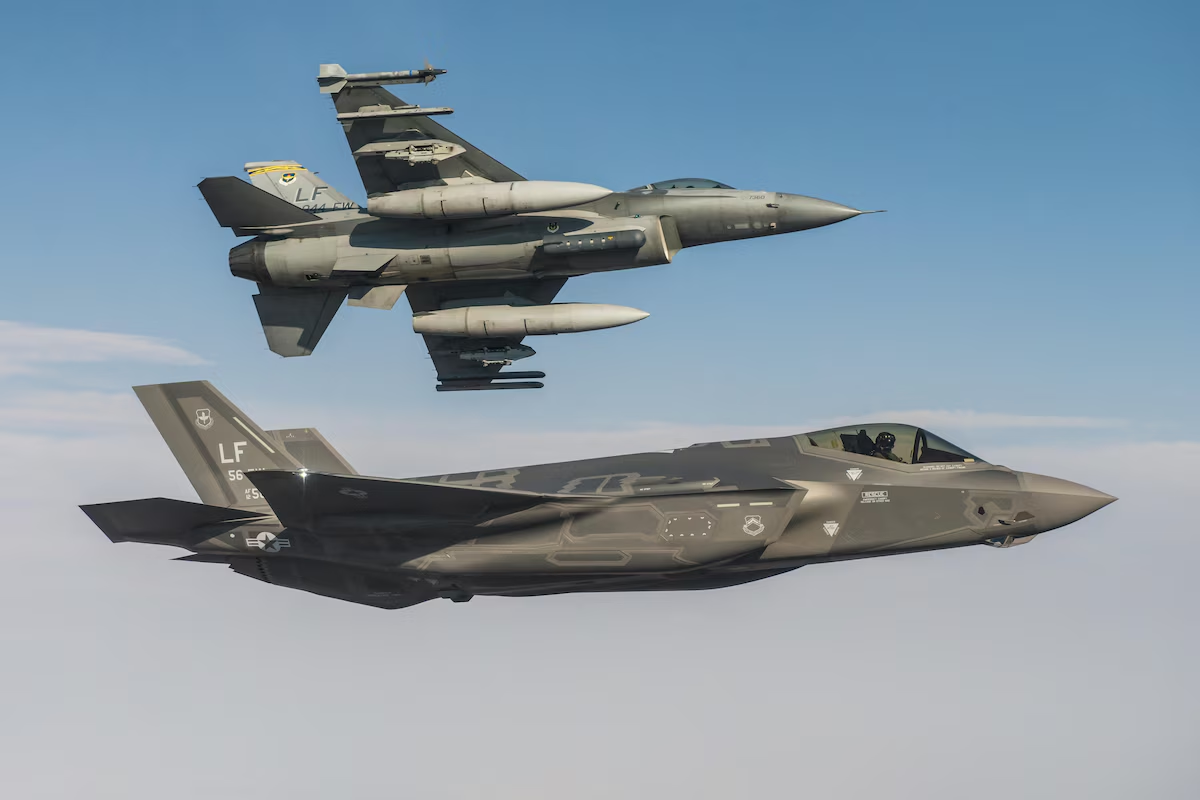
The F-35 Lightning II: Replacing the Legendary F-16
Since the late 1970s, the F-16 Fighting Falcon, developed by General Dynamics and later Lockheed Martin, has been a pivotal light fighter for the United States and its allies. However, the aircraft’s design belongs to an era preceding digital cockpits and stealth technologies. By the late 1990s, the airframe had been extensively upgraded, reaching its limits.
The United States initiated the Joint Strike Fighter (JSF) program to field a new class of fighter jets that could replace multiple fourth-generation aircraft, including the F-16. Lockheed Martin’s F-35 Lightning II, designed for low observability and advanced sensor capabilities, emerged as the chosen successor.
The Fifth-Generation Upgrade
The transition to the F-35 has begun across the US Air Force, with squadrons replacing F-16s with the F-35A model. Internationally, this shift is echoed in countries like the UK, Italy, Australia, and Japan, with nations like Poland and Greece awaiting deliveries.
Stealth technology is a significant driver of this change. The F-16 is easily detectable on modern radar systems, making it vulnerable to long-range attacks. The F-35’s stealth design offers a critical advantage, allowing pilots to operate undetected and complete missions effectively.
Advanced Capabilities
- Integrated sensors offering continuous communication with ground, sea, and space units.
- A helmet visor providing a panoramic display, streamlining data from various sensors.
- Enhanced decision-making capabilities for pilots, compared to the F-16’s traditional and separate displays.
Performance and Specifications
The F-35 can cover more ground without external fuel tanks due to its large internal reserves. It also meets reliability standards while delivering significantly more thrust than the latest F-16 models. The F-35 family includes:
- F-35A: For conventional takeoff and landing
- F-35B: Suitable for short takeoff and vertical landing
- F-35C: Designed for aircraft carrier operations
| Specification | F-35A |
|---|---|
| Power Plant | One Pratt & Whitney F135-PW-100 turbofan engine |
| Thrust | 43,000 pounds |
| Wingspan | 35 feet (10.7 meters) |
| Speed | Mach 1.6 (~1,200 miles per hour) |
| Range | More than 1,350 miles (1,200+ nautical miles) with internal fuel, unlimited with aerial refueling |
The Case for the F-35
Despite its higher cost, the F-35’s advantages outweigh those of the aging F-16. Advanced stealth features, sensor superiority, and extended range provide a significant qualitative edge.
Operators like Italy, Norway, and Israel are progressively integrating the F-35 in place of their F-16s. Countries such as South Korea, Japan, and Singapore are also starting to transition or supplement their fleets with the F-35.
Why Replace the F-16?
The primary reasons include survivability and advanced system integration in hostile defense environments, where the F-16’s radar signature is a liability.
| Specification | F-16C/D |
|---|---|
| Thrust | 27,000 pounds |
| Speed | 1,500 mph (Mach 2) |
| Range | More than 2,002 miles (1,740 nautical miles) |
| Wingspan | 32 feet, 8 inches (9.8 meters) |
| Maximum takeoff weight | 37,500 pounds (16,875 kilograms) |
High Tech Evolution
The F-35’s sensor suite and electronic warfare capabilities represent a major advancement. Its radar cross-section allows it to evade detection and engage in protected operating environments.
Future-Proof Features
The F-35 was designed with future upgrades in mind, from modular computer systems for ease of updates to robust electrical and heat management capacities, allowing for significant technological enhancements over time.
Overall, the F-35 Lightning II sets a new standard for adaptability and capability, positioning it as a cornerstone of modern air defense strategies.