
Boeing vs. Lockheed Martin: The 2025 Military Aircraft Market Showdown
The competition between Boeing and Lockheed Martin for dominance in the military aircraft sector in 2025 is a critical issue extending beyond aviation enthusiasts. This battle involves technological prowess, defense policies, and national security implications. Both companies have played pivotal roles in shaping military aviation history, influencing the United States and allied air forces worldwide.
Boeing Overview
| Detail | Boeing |
|---|---|
| Stock Code | BA |
| Business Type | Planemaker |
| Date Founded | July 15, 1916 |
| CEO | Kelly Ortberg |
| Headquarters | Chicago, USA |
| Key Product Lines | Boeing 737, Boeing 747, Boeing 757, Boeing 767, Boeing 777, Boeing 787 |
This analysis examines Boeing’s and Lockheed Martin’s key aircraft programs, defense contracts, and global positioning as they vie for supremacy in 2025. The competition’s impact on military strategy and the aviation industry is profound.
Lockheed vs. Boeing: Market Dynamics in 2025
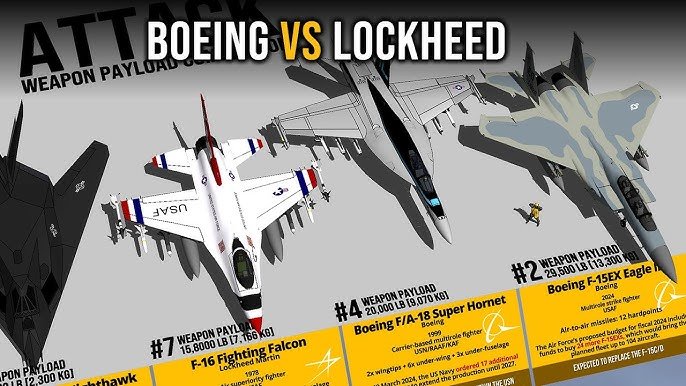
In 2025, Lockheed Martin seemingly leads the military aircraft market, primarily due to the success of its F-35 Lightning II program. However, Boeing remains a significant player with the KC-46 Pegasus tanker, P-8 Poseidon maritime patrol aircraft, F-15EX Eagle II, C-17 Globemaster III, and the enduring B-52 Stratofortress.
Lockheed’s dominance is clear in revenue and global market share. Boeing strategically positions itself in critical USAF modernization programs. While Lockheed shines in stealth fighters, Boeing excels in bombers, transport, refueling, and maritime patrol roles.
Notably, Boeing’s win of the Next Generation Air Dominance (NGAD) contract to develop the USAF’s future F-47 fighter enhances its future position. Participation in the Navy’s F/A-XX program, where Lockheed is absent, further cements Boeing’s role in future fighter programs. Boeing’s comprehensive portfolio in nearly every mission profile bolsters its strategic position.
Factors Influencing the Defense Aviation Race
The balance between Lockheed Martin and Boeing is influenced by several factors:
- Aircraft portfolio strength: Variety and appeal across mission types.
- Defense contract awards: Frequency of new US and allied government deals.
- Global partnerships: Integration with allied nations and defense ecosystems.
- Technological innovation: Investment in new capabilities such as stealth, drones, and AI.
- Program execution: Timely delivery of complex projects within budget.
Lockheed’s F-35 program, with commitment from over 20 countries, is the most widely adopted fifth-generation fighter. Boeing’s NGAD F-47 win, coupled with involvement in the Navy’s F/A-XX competition, positions it uniquely across both the Air Force and Navy’s future fighter programs, granting influence over sixth-generation combat aviation.
| Category | Lockheed Martin | Boeing |
|---|---|---|
| Fighters | F-35 Lightning II, F-22 (legacy support) | F-15EX Eagle II, F/A-18E/F Super Hornet |
| Bombers | N/A | B-52 Stratofortress, B-1B (support), B-2 (support) |
| Tankers | N/A | KC-46A Pegasus, KC-135 (legacy support) |
| Patrol/Recon | N/A | P-8A Poseidon |
| Transport Aircraft | C-130J Super Hercules | C-17 Globemaster III |
| Helicopters | Sikorsky UH-60 Black Hawk (via Lockheed) | AH-64 Apache, CH-47 Chinook |
| Drones / Advanced Tech | Loyal Wingman concepts | MQ-25 Stingray |
Lockheed maintains current export and interoperability advantages, but Boeing is well-positioned for future innovation and Air Force commitments. This disparity prevents a clear winner from emerging in defense aviation, as both companies specialize in different domains.
Government Choices in 2025
Government procurement decisions significantly impact the future of military aviation. In 2025, the US Department of Defense continues to invest heavily in Lockheed Martin’s F-35 Lightning II, a cornerstone of allied air power. This commitment is echoed by European and Asian partners, underscoring its international appeal.
Conversely, Boeing is pivotal in numerous mission-critical programs. The USAF depends on the KC-46A Pegasus for aerial refueling and maintains the B-52 fleet. Boeing’s P-8 Poseidon appeals to several countries, while the C-17 remains vital for mobility through sustainment contracts.
Three primary factors drive procurement decisions:
- Cost and lifecycle management: Justifying the expense of long-term sustainment.
- Mission requirements: Aligning platforms with operational needs.
- Alliance politics: Maintaining interoperability with US and NATO forces for joint operations.
These factors reveal that while Lockheed benefits from the F-35’s success, Boeing serves essential roles in operational areas not covered by Lockheed. Both companies remain crucial players in diverse mission spaces.
Competition Beyond US Firms
While Boeing’s diverse portfolio across defense and commercial sectors provides resilience, European competitors like Airbus, Dassault, and Saab present challenges. Airbus’s A330 MRTT enjoys tanker success, while Dassault’s Rafale and Saab’s Gripen secure export deals. However, the scale of Lockheed and Boeing operations limits these successes.
| Rank | Manufacturer | Fighter Model(s) | Estimated Export Units (2025) | Key Importing Countries |
|---|---|---|---|---|
| 1 | Lockheed Martin | F-35 Lightning II | 800+ | USA, UK, Japan, Australia, Poland, Finland, Israel, South Korea, Italy, Netherlands |
| 2 | Dassault Aviation | Rafale | 250+ | India, Egypt, Greece, UAE, Indonesia, Qatar |
| 3 | Boeing | F-15EX, F/A-18E/F Super Hornet | 200+ | Saudi Arabia, Indonesia, Kuwait |
| 4 | Saab | Gripen E/F | 100+ | Brazil, Sweden, Czech Republic, Thailand |
| 5 | Eurofighter Gmbh | Typhoon | 90+ | Germany, Spain, Italy, UK, Austria, Qatar, Saudi Arabia |
| 6 | Chengdu aircraft | J-10C, J-20 (limited exports) | 100+ (Potential) | Pakistan, potential interest from the Middle East and African partners |
| 7 | Sukhoi | Su-30, Su-35 | 100+ (Potential) | India, Algeria, Vietnam, limited sales to China |
Lockheed dominates in stealth fighters globally, while Boeing secures key US Air Force roles. European options, although relevant, do not surpass the influence of these American giants.
Challenges Facing Both Boeing and Lockheed
Boeing and Lockheed contend with pressing challenges. Lockheed’s F-35 sustainment costs are a concern, potentially burdening defense budgets. Allies may reconsider long-term expenses, which could impact Lockheed’s market stronghold.
Boeing faces its own hurdles. The KC-46 Pegasus, despite gaining traction, has grappled with technical issues that have hindered trust. Boeing’s F-15EX and F/A-18 Super Hornet are modernized but rely on older generational designs, potentially rendering them outdated as fourth-generation bases give way to more advanced technologies.
Boeing’s NGAD F-47 victory puts it back on the cutting edge, offering prospects of next-generation advancements. Nevertheless, historical issues of delays and budget overruns loom, and the NGAD may not achieve the global reach of Lockheed’s F-35 program.
Future Outlook
In 2025, Lockheed Martin holds an edge, largely due to the widespread adoption of the F-35 in NATO and beyond. However, Boeing remains essential in tankers, maritime patrol, and upgraded fighter roles, maintaining US military flexibility and sustainability.
The true competition lies in the sixth-generation fighter market. The NGAD and similar international programs will determine whether Lockheed or Boeing guides the next chapter of combat aviation. The race, while favoring Lockheed currently, remains ongoing and fiercely competitive.