
Boeing 747 vs. Airbus A380: Current Utilization in Aviation
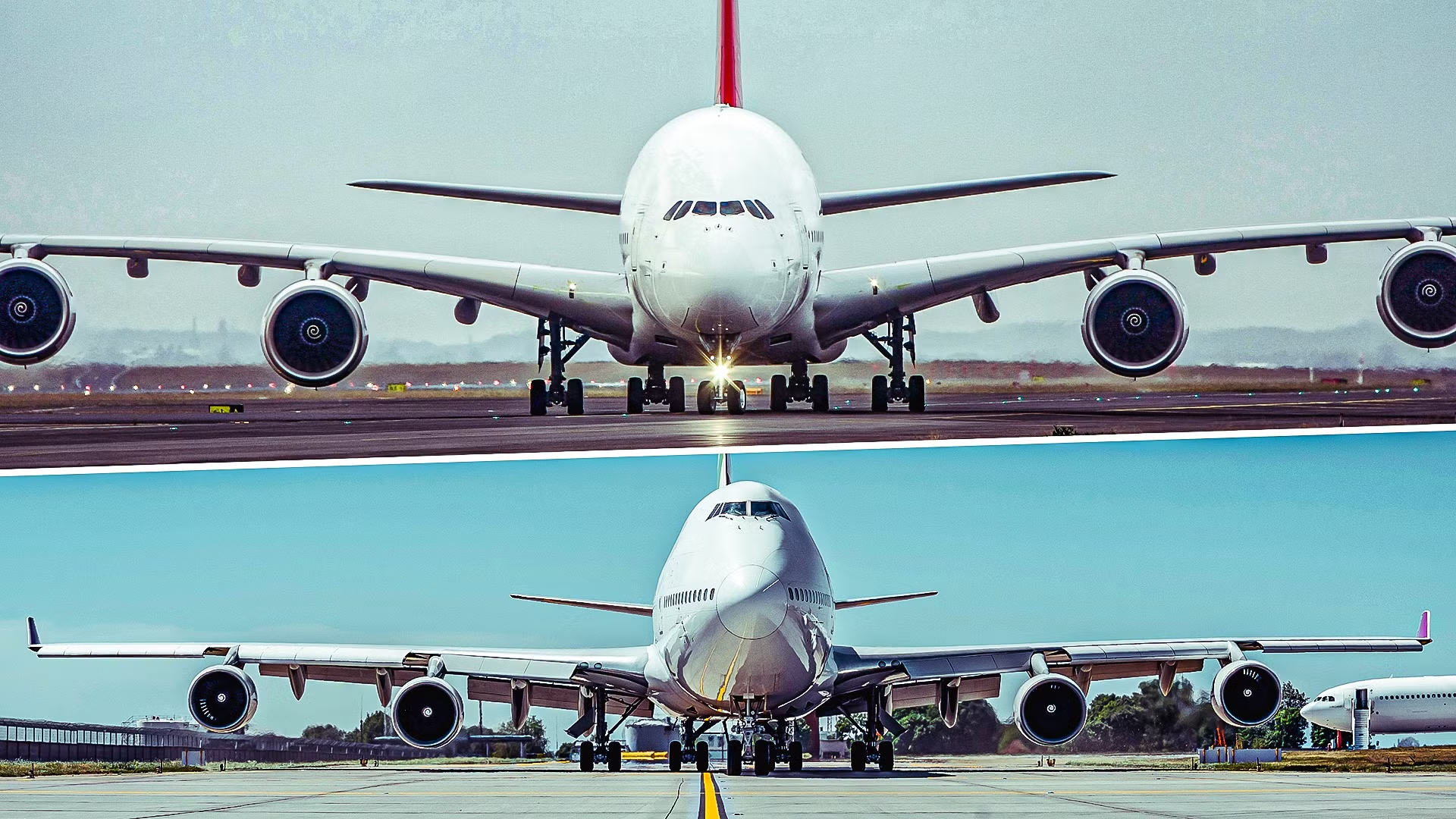
The Boeing 747 and Airbus A380 stand as the largest airliners in service today, recognized for their dual passenger decks that accommodate vast numbers of passengers on extensive routes. Both aircraft, celebrated for their designs and spacious cabins, continue to serve a distinctive role in aviation by focusing on high-density hub-to-hub routes. Despite ceasing production in recent years, it’s crucial to assess how many of these iconic aircraft remain operational.
Current Availability
Data from ch-aviation reveals compelling insights regarding both the 747 and A380. During 55 years of production, Boeing built 1,574 units of the 747, with 355 units presently active, serving commercial, freight, and military roles. The oldest, registered as 5-8103, flies with Iran’s Air Force, nearing 55 years in service.
The A380, a newer entrant by Airbus, produced only 254 units over 18 years (2003-2021). Currently, 157 A380s remain operational, mostly in commercial passenger service, with the oldest unit, registered as F-WWOW, over 20 years old and used by Airbus as a test aircraft. Notably, 22.6% of 747s are still operational, compared to 61.8% of A380s, owing to more modern construction and equipment.
Background and Features
The Boeing 747, dubbed the “Jumbo Jet,” is iconic for being the first widebody aircraft. It debuted on January 22, 1970, with Pan Am and maintained the passenger capacity record for 37 years. Its upper deck typically serves as a first-class lounge but was once configured with additional seating. In contrast, Airbus designed the A380 to rival the 747 by offering full-length upper-deck seating, allowing varied configurations, with some airlines opting for high-density economy class setups.
Passenger Preferences
A Reddit discussion highlighted passenger preferences, indicating the A380 as an unmatched option for comfort, though many cherished the experience of flying a 747 due to its declining availability. The 747’s upper-deck lounge was particularly praised, described as both private and club-like.
| 747-8 | A380 | |
|---|---|---|
| Typical Seating | 467 | 525 |
| Maximum Seats | 605 | 853 |
| Range | 7,730 nmi (14,320 km) | 7,991 nmi (14,800 km) |
| Cruise Speed | Mach 0.855 (504 kn; 933 km/h) | Mach 0.85 (488 kn; 903 km/h) |
| Length | 250 feet, 2 inches (76.25 m) | 239 feet (72.84 m) |
| Wingspan | 224 feet, 7 inches (68.45 m) | 261.8 feet (79.8 m) |
| Maximum Takeoff Weight | 987,000 lbs | 1,268,000 lbs |
| Fuel Capacity | 63,034 US gal | 84,535 US gal |
| Powerplant | 4x GEnx-2B67, 66,500 lbf (296 kN) thrust | 4x Rolls-Royce Trent 970-84, 75,152 lbf (334 kN) thrust |
The Future of Quadjets
Fuel efficiency drives today’s aviation industry, urging airlines to choose smaller, more efficient aircraft like the Airbus A350 and Boeing 787 Dreamliner. Designed with advanced turbofan engines and lightweight materials, these models outshine both the 747 and A380 in economical performance.
As aviation rebounds from the COVID-19 pandemic, some industry players see a potential resurgence of the A380. Airlines like Emirates express interest in a modernized A380neo to address high passenger demands.
| Aircraft Model | Introduction Year |
|---|---|
| Airbus A380-800 | 2007 |
| Boeing 747-8 | 2011 (cargo), 2012 (passenger) |
| Boeing 787 Dreamliner | 2011 |
| Airbus A350 | 2015 |
| Airbus A330neo | 2018 |
| Boeing 777X | 2026 (planned) |