
American Airlines Expands Ultra-Long-Haul Routes with Boeing 787-9 Dreamliner in 2025
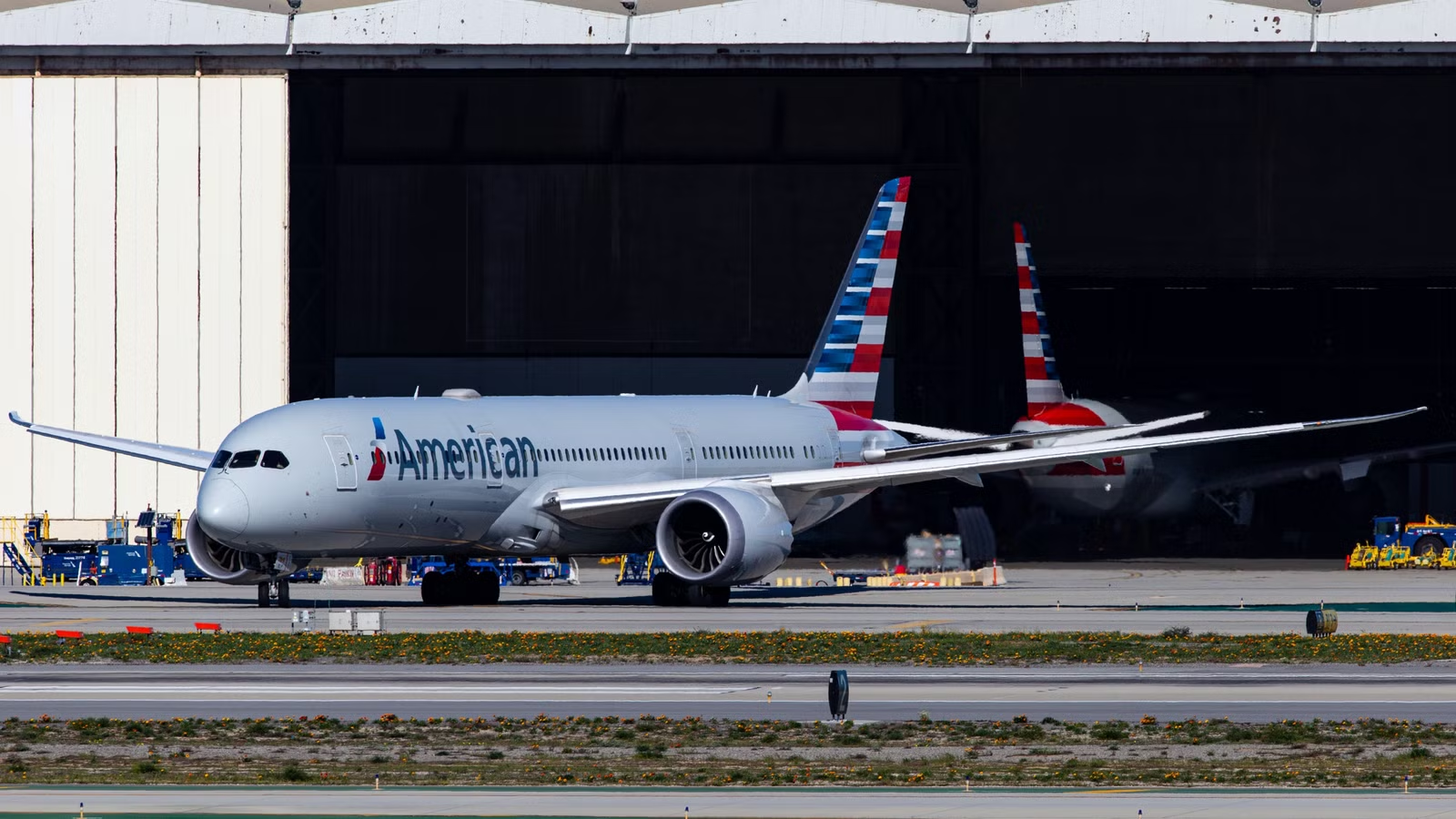
American Airlines has been expanding its long-haul travel capabilities, utilizing the Boeing 787-9 Dreamliner to connect distant parts of the world more seamlessly. The airline’s longest routes not only demonstrate the technological advancements in modern aviation, such as improved fuel efficiency and passenger comfort, but also align with changing international travel priorities, enhancing direct connectivity and premium services.
Ultra-Long-Haul Global Connectivity: 7,000 To 9,000 Miles
Many of American Airlines’ ultra-long-haul routes span 7,000–9,000 miles, linking the U.S. with significant global destinations. The longest is between Dallas/Fort Worth International (DFW) and Brisbane Airport (BNE), covering approximately 8,299 miles. American has scheduled around 144 flights each way for this route in 2025, offering nearly 39,000 seats per leg. This service connects Texas to Australia’s third-largest city, demonstrating increased transpacific travel demand beyond traditional hubs like Los Angeles.
Another vital route is DFW to Auckland Airport (AKL) at 7,439 miles, with 138 flights each direction and over 39,000 seats, enhancing American’s Pacific influence. In Asia, the DFW to Shanghai Pudong International Airport (PVG) route covers 7,351 miles, with 248 eastbound and 247 westbound flights, providing the highest seat volume among 7,000–9,000-mile routes, highlighting Shanghai’s economic prominence.
Long-Haul Transoceanic and Intercontinental Services: 5,000 To 7,000 Miles
American Airlines also operates various long-haul transoceanic flights in the 5,000–7,000-mile range, linking the U.S. to South America, Europe, and Asia. Notably, the JFK to Tokyo Haneda (HND) service at 6,773 miles includes 359 flights each way and over 102,000 available seats. This route underscores the robust demand for uninterrupted U.S.-Japan travel, as Tokyo continues as a crucial hub.
In South America, DFW to Buenos Aires’ Ezeiza International Airport (EZE) spans 5,286 miles with about 66 flights each way and more than 16,000 seats. A similar scale is seen in the DFW to Sao Paulo Guarulhos International Airport (GRU) at 5,111 miles, hosting 366 flights each way and over 103,000 seats. These connections are essential for U.S.-South America trade and corporate travel.
Comparing American’s Longest Routes
Routes within the 5,000–7,000-mile range significantly support American’s long-haul operations. These routes account for a large share of long-haul seat miles, facilitated by high passenger volumes between well-established business and cultural centers. In contrast, the fewer 7,000–9,000-mile routes extend American’s global presence, targeting long-haul leisure and premium business travel markets.
| Mileage Band | Flights | Seats | ASMs | Avg. Distance |
|---|---|---|---|---|
| 5,000–7,000 | 3,039 | 859,760 | 5.24 billion | ~5,986 miles |
| 7,000–9,000 | 1,059 | 297,059 | 2.26 billion | ~7,696 miles |
Domestic and Overseas Connectivity: 2,000 To 5,000 Miles
The 2,000–5,000-mile segment includes many transatlantic services, like the Philadelphia to London Heathrow route at 3,546 miles, boasting 576 annual flights per direction and over 156,000 seats. This range encompasses essential South American routes too, such as JFK to GRU at 4,745 miles with 366 flights per direction and more than 104,000 seats, facilitating both corporate and leisure traffic.
| Route | Distance (miles) | Flights | Seats | ASMs |
|---|---|---|---|---|
| LHR–ORD | 3,953 | 933 | 245,487 | 970,410,111 |
| ORD–LHR | 3,953 | 933 | 245,405 | 970,085,965 |
| LHR–PHL | 3,546 | 576 | 156,124 | 553,615,704 |
Widebody Deployments on Short-Haul Routes: Under 2,000 Miles
American occasionally uses the 787-9 for short-haul routes under 2,000 miles, mainly for fleet positioning or capacity demands. This includes services like DFW to Phoenix at 868 miles and DFW to Las Vegas at 1,055 miles.
Overall, American Airlines’ strategic use of the Boeing 787-9 reflects its ability to adapt for both long-haul and short-haul deployments, confirming its central role in strengthening the airline’s international and domestic network.