
Airbus A350 Freighter: Orders and Industry Impact
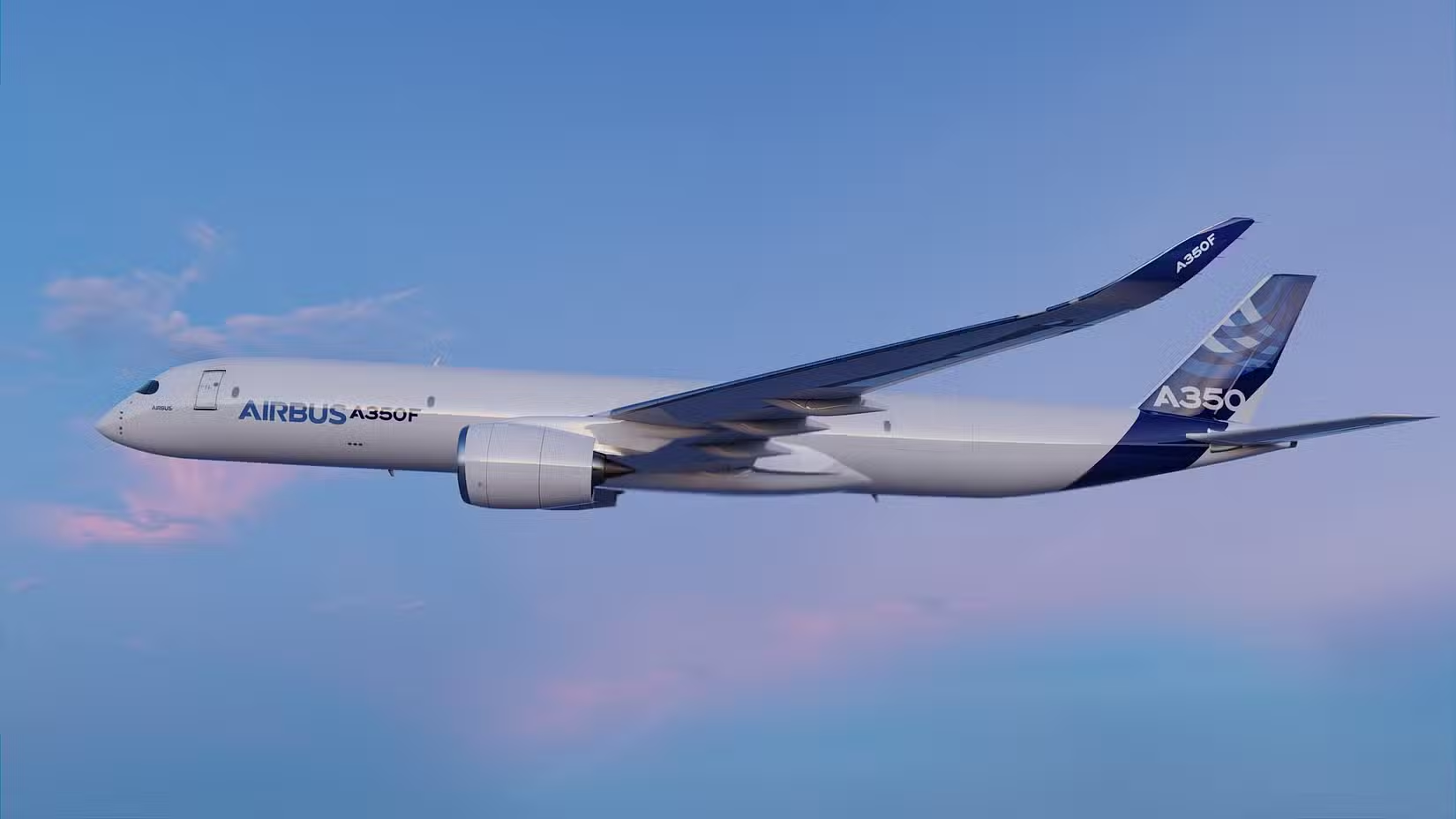
The Airbus A350 freighter (A350F) represents a strategic move by Airbus to boost its presence in the global cargo market, traditionally dominated by Boeing. With less than 10% of the dedicated global cargo fleet under its wing, Airbus aims to revamp its standing through the A350F, a purpose-built widebody freighter based on the A350-1000 platform.
A350F Orders and Market Expectations
Airbus has secured approximately 68 orders for the A350F, positioning it as a potential game-changer in the air cargo sector. While the International Air Transport Association (IATA) forecasts air cargo demand to grow by about 4.8% this year, broader industry projections suggest the need for approximately 4,000 new freighters by 2044. The A350F, expected to meet ICAO’s 2027 carbon emission standards, promises up to 40% lower fuel burn and emissions than its competitors.
Supply Chain Challenges Impacting Timeline
The A350F’s introduction has been marred by delays, primarily due to supply chain issues with Spirit AeroSystems, a key component manufacturer. Initial entry into service was set for 2025, later postponed to 2026, and most recently to the second half of 2027. Airbus has taken steps to stabilize its supply chain, including a $439 million deal to acquire Spirit’s Airbus-related operations across several international facilities.
Progress Despite Order Adjustments
- Airbus has made significant progress with the initial test aircraft. Notably, the first wingset and horizontal stabilizer have been completed and shipped for assembly.
- Despite advancements, delays have resulted in some order modifications. Air Lease Corporation canceled its initial commitment, and Air France-KLM Group reduced its order from eight to six aircraft.
Current Backers of the A350F
Despite setbacks, key airlines like Etihad Airways and Taiwan’s STARLUX remain committed, each ordering ten A350Fs. Other supporters include CMA CGM Air Cargo, Cathay Pacific, Singapore Airlines, Silk Way West, Turkish Airlines, and lessors like AviLease and MNG Airlines.
Comparative Advantages of the A350F
| Specification | Airbus A350F |
|---|---|
| Overall Length | 232 feet, 4 inches (70.8 meters) |
| Wingspan | 212 feet, 5 inches (64.75 meters) |
| Overall Height | 56 feet, 1 inch (17.08 meters) |
| Max. Takeoff Weight (MTOW) | 319 tonnes |
| Max. Landing Weight (MLW) | 252 tonnes |
| Main Deck Containers | 30 containers |
| Lower Deck LD3 | 40 LD3 |
The A350F boasts 20% less fuel burn compared to the Boeing 777F, and 40% less than the 747-400F, offering significant operational cost reductions.
Future of the Freighter Market
Airbus and Boeing are set to compete fiercely in the next-generation freighter market, with Boeing advancing its 777-8F. For Airbus, successful delivery on current A350F orders could help it secure a larger share of this critical sector.