
Families Sue Boeing and Honeywell Over Air India Boeing 787 Crash
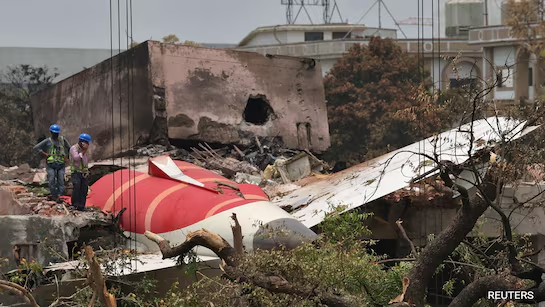
The families of four passengers who perished in the crash of Air India Flight 171 have filed a lawsuit in the United States against Boeing and Honeywell, citing negligence. The Boeing 787 Dreamliner, which was destined for London Gatwick (LGW), crashed shortly after taking off from Ahmedabad (AMD) in June, resulting in the deaths of 260 people. The lawsuit claims that defective fuel switches were responsible for the crash and accuses Boeing and Honeywell of ignoring known risks.
Details of the Lawsuit
Filed in a U.S. court and reviewed by the BBC, the lawsuit alleges that Boeing and Honeywell disregarded safety concerns linked to the Dreamliner’s fuel control switches. These switches allegedly allowed for unintentional movement from the “run” to the “cut-off” position, severing the engines’ fuel supply soon after takeoff, according to the complaint. India’s Aircraft Accident Investigation Bureau (AAIB) found in its preliminary report that the fuel cutoff resulted in a loss of thrust, leading to the crash. The families argue this indicates a design flaw and assert that the mechanism should have been designed to prevent such accidental shutdowns.
Failure to Take Corrective Action
Despite warnings, the lawsuit contends that both Boeing and Honeywell did not issue mandatory safety instructions or offer replacement parts. It underscores a 2018 FAA advisory that recommended inspecting the switches’ locking mechanism but did not require compliance. The families criticize Boeing and Honeywell for relying on a “gentle advisory” and not taking corrective steps, leaving the defect unresolved.
Background of the Crash
Air India Flight 171 took off from Ahmedabad (AMD) for London Gatwick (LGW) carrying 229 passengers and 12 crew members. Tragically, it also led to the deaths of 19 people on the ground, totaling 260 fatalities. The engines lost thrust shortly after takeoff due to a cutoff in the fuel supply. Investigators suggest the fuel control switch was inadvertently shifted to cut off the engines, placing these switches at the forefront of ongoing investigations. While Boeing has declined to address the lawsuit, referring instead to the AAIB’s initial report, Honeywell has yet to release a statement. A detailed investigation report is anticipated by 2026.
Implications for the Aviation Industry
The case underscores broader industry concerns about the effectiveness of non-mandatory advisories. The 2018 FAA notice on Dreamliner fuel switches suggested—but did not enforce—safety inspections. The victims’ families argue this approach left airlines susceptible to catastrophic mechanical failures. If U.S. courts determine that Boeing and Honeywell had prior knowledge of the defect and failed to act, the lawsuit could have significant implications for both companies. Safety analysts suggest the verdict may impact future regulations concerning mandatory compliance for critical aircraft components.