
Boeing 777-9 Brake Certification Achievements
The Boeing 777-9 team recently completed essential braking certification tests at Clinton Sherman Airport (CSM) in Oklahoma, despite facing severe weather conditions. This testing, crucial for Boeing’s new widebody jet used by major airlines such as Emirates (EK) and Qatar Airways (QR), extended over a period of 63 days, more than twice the initially projected time. Led by test director Madison Strauss, the team carried out comprehensive evaluations on the first 777-9 test aircraft, labeled WH001. To overcome weather-related disruptions, operations were temporarily moved to Lubbock Preston Smith Airport (LBB) in Texas, ensuring compliance with safety standards for the world’s largest twin-engine jet.
Testing Procedures and Challenges
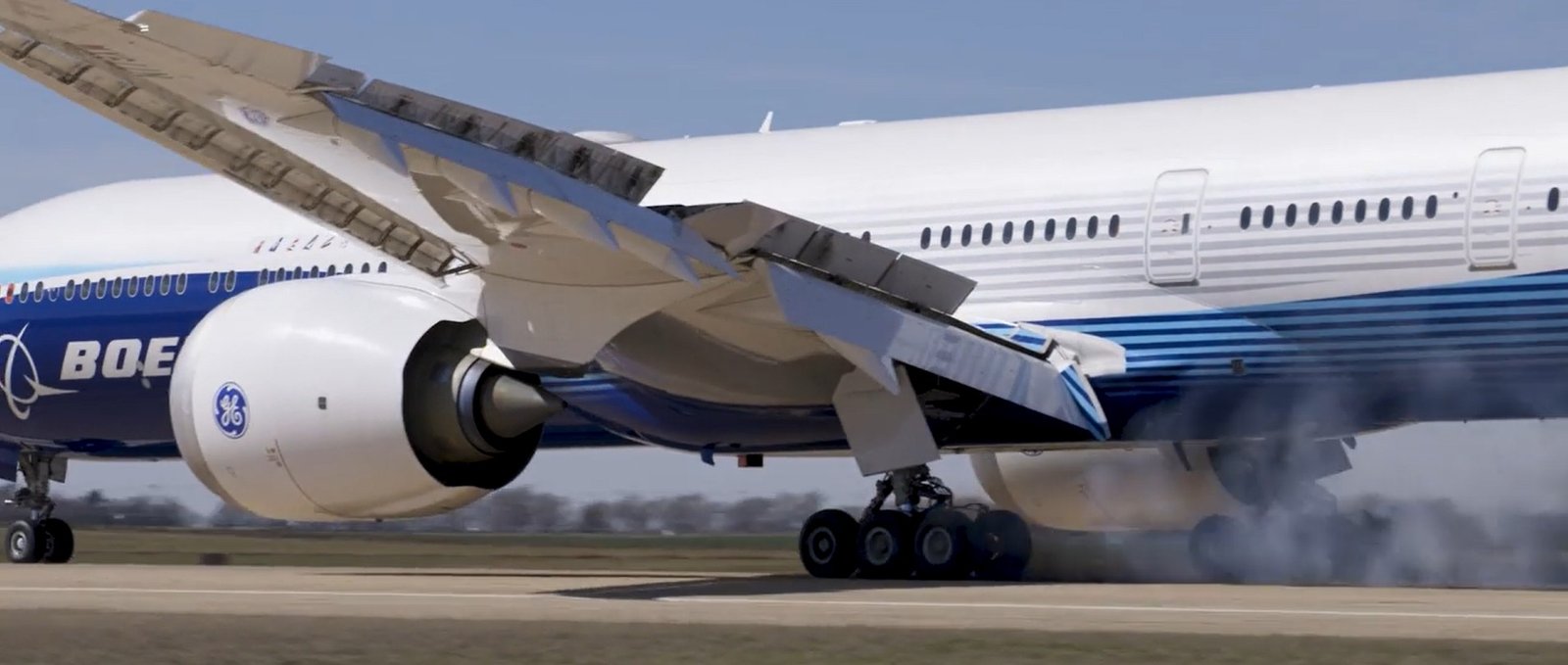
In March, the team set up at CSM to assess the brake and wheel performance in dry weather. These tests involved rigorous braking maneuvers to establish operational thresholds and gather critical data for regulatory approval. As project pilot Heather Ross noted, these tests aim to thoroughly understand the aircraft’s limits and meet both internal and regulatory expectations.
Calm wind conditions under 10 knots (12 mph) and dry runways were essential for accurate testing, conditions not typically found during Oklahoma’s spring. Strauss explained that the analysis team imposed strict wind limits to separate brake performance from external influences. The predominant high winds often interrupted testing, causing the team to conduct crosswind evaluations in Lubbock (LBB). Severe storms periodically necessitated aircraft evacuations, prolonging the testing phase beyond the original 30-day forecast.
Complex Logistics and Team Dynamics
Executing remote testing required detailed logistical arrangements and support from a multidisciplinary team both on-site and at Boeing’s Seattle headquarters, Boeing Field (BFI). Marlon Mercado, a flight test maintenance specialist, highlighted the logistical difficulties: “Ensuring the availability of appropriate equipment, tools, and parts for 24-hour operations, divided into two 12-hour shifts, presents significant challenges.”
Instrumentation engineer Jeff Un added, “An equally effective team in Seattle supports every person onsite, maintaining the momentum of testing despite unpredictable conditions.” The team’s adaptability was demonstrated when adverse weather necessitated changes in their schedule, allowing crosswind tests in Texas even during high winds.
Recognition and Future Testing
The dedication of the team was evident as they faced long hours on-site away from home, with their motivation stemming from the mission’s significance. Flight test engineer Kyle Ator remarked on the team’s “singular focus,” which fostered unity and made their efforts gratifying. Team members came together to overcome various challenges, illustrating their resilience through long waits for favorable wind conditions to achieve test points.
The Boeing 777-9 program advances with upcoming tests that will simulate ice formation on wings and wet runway braking. Following its first flight on January 25, 2020, and powered by GE9X engines, the aircraft is set for delivery in 2026, poised to redefine long-haul aviation with its innovative design and superior efficiency.
Technical Specifications and Passenger Benefits
The 777X series, comprising the 777-9 and 777-8, boasts distinctive folding wingtips, which reduce the ground wingspan and allow compatibility with standard airport gates. This design optimizes aerodynamic efficiency, enhancing lift-to-drag ratios and fuel savings during flights. With a length of 76.72 meters, the 777-9 can accommodate 426 passengers over a distance of 7,285 nautical miles (13,500 km), while the shorter 777-8 can travel 8,730 nautical miles (16,170 km) with 384 passengers.
The cabin, inspired by the 787 Dreamliner, features larger windows, a spacious interior, quieter acoustics, and higher humidity to improve passenger comfort. The GE9X engines set a Guinness World Record in 2019 for thrust and consume 10% less fuel than their predecessors. MTU Aero Engines, a significant contributor to the GE9X program, produced the turbine center frame, which withstands extreme temperatures and sustains the advanced propulsion system found in the 777X.
Innovative Features and Prospects
The 777X’s carbon fiber reinforced polymer wings and folding wingtips represent significant advancements, enhancing efficiency and adaptability at airports. As the aircraft nears its 2026 debut, these attributes, confirmed through extensive testing, indicate its potential to revolutionize air travel.