
Boeing 707‘s Four Engines: A Necessary Choice for Its Time
Boeing is a leading name in the aircraft manufacturing industry, employing nearly 50,000 individuals worldwide in its commercial aviation sector, notably at facilities in Everett, Washington, and Charleston, South Carolina. Established in July 1916, Boeing has become a giant in aerospace, reporting nearly $33 billion in revenue for 2024.
Development and Characteristics of the Boeing 707
The Boeing 707 was pivotal in Boeing’s ascent in the aviation industry, renowned for its significant contribution to commercial aviation. As a narrowbody aircraft, it featured several unique aspects, most notably its four-engine design, crucial for the technological and regulatory landscape of its time.
Why a Four-Engine Design?
In the early 1950s, jet engine technology was underdeveloped compared to today. Jet engines of that era lacked the power to individually propel large, long-range aircraft. Hence, Boeing adopted a four-engine configuration for the 707 to ensure adequate thrust for takeoff, cruising, and long-haul travel.
- Safety was a critical factor; engines of the time were less reliable, and inflight engine failure was a concern. With four engines, the aircraft could maintain operation even with one engine failure.
- Regulatory mandates necessitated the use of three or four engines for transoceanic travel, as two-engine flights were restricted on such routes due to safety concerns. This made the four-engine design imperative for the Boeing 707’s operation on international routes.
From Development to Commercial Service
Boeing’s success in World War II military aircraft paved the way for its work with jet technology in the late 1950s, leading to the Boeing 367-80 prototype. This aircraft showcased the capabilities of jet-powered commercial flight.
| Specification | Detail |
|---|---|
| Length | 127 feet 10 inches |
| Wingspan | 129 feet 8 inches |
| Range | 3,070 nautical miles |
| Typical cruise speed | 480 knots |
The 707, a commercial adaptation, featured a longer and wider fuselage, accommodating five-abreast seating, thus remaining competitive against rival aircraft like the Douglas DC-8.
Starting Commercial Operations
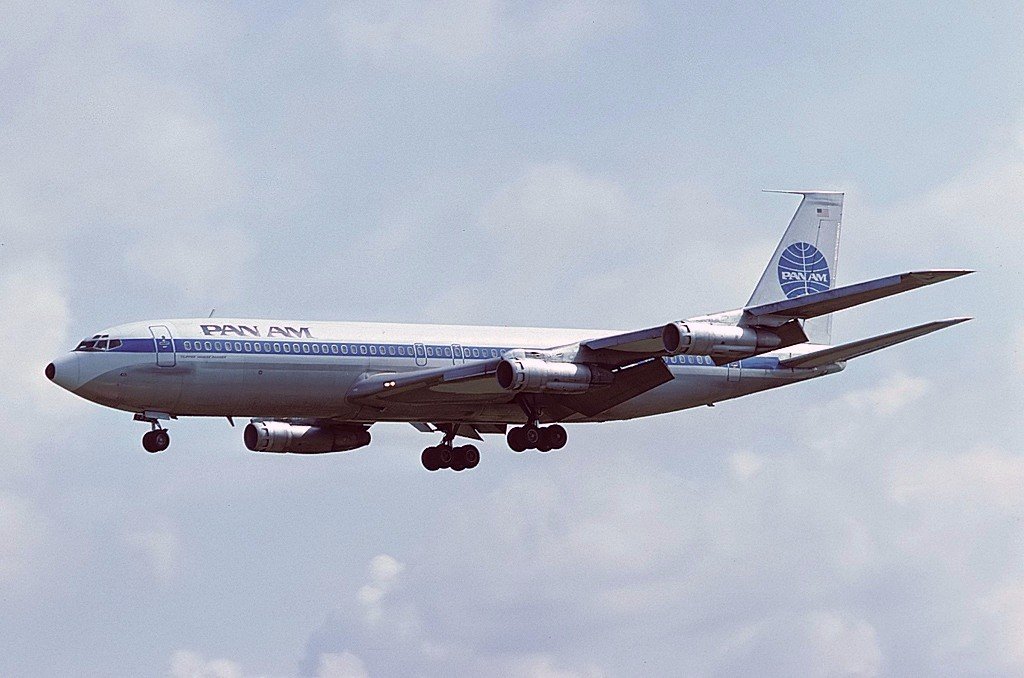
The Boeing 707 first flew on December 20, 1957, later entering commercial service with Pan American World Airways on October 26, 1958. The maiden service from Idlewild Airport, now JFK International, to Orly Airport in Paris, with a refueling stop in Gander, Newfoundland, highlighted its efficiency over predecessor piston aircraft.
| Variant | First Flight |
|---|---|
| 707-120 | 1957 |
| 707-320 | 1959 |
Global Reach and Legacy of the Boeing 707
Many airlines globally adopted the Boeing 707. Pan Am, as the launch customer, pioneered its use, accumulating over 130 aircraft. American Airlines, TWA, and British Airways also became major operators.
| Airline | Total Boeing 707s |
|---|---|
| Pan Am | 130+ |
| American Airlines | 120+ |
Today, commercial operations of the 707 have ceased, supplanted by more efficient modern aircraft. However, military variants like the E-3 Sentry continue operational with modern upgrades like CFM56 engines. Some private or governmental entities, such as the Congo Presidential Flight, also maintain operational 707s.
Key Design Features
The Boeing 707’s swept-wing design facilitated high-speed, efficient flight. Its turbojet and later turbofan engines provided significant thrust, supporting long-range travel. The pressurized cabin enabled optimal operational altitudes.
| Feature | Specification |
|---|---|
| Wingspan | 145 feet 9 inches |
| Maximum speed | Mach 0.887 |
The Boeing 707 remains a legendary aircraft, setting a foundational precedent in the commercial aviation industry.