
The Airbus A380 and Boeing 747: An Overview
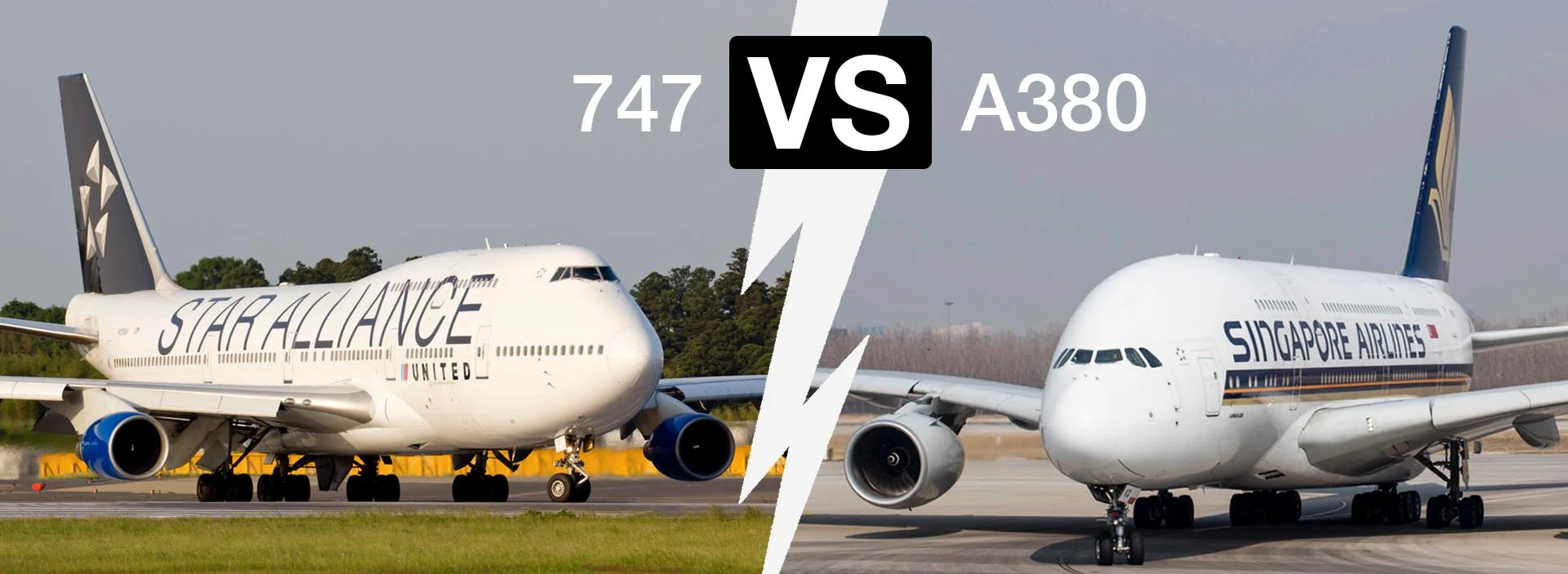
The Airbus A380 and Boeing 747 are among the most recognizable aircraft, despite their numbers dwindling and their dominance as widebody jets diminishing. The A380, a four-engine widebody, offers significant capacity with two full-length passenger decks connected by staircases. It is designed to be the highest-capacity passenger aircraft ever.
| Airbus A380 | Launch Customer(s): Singapore Airlines | First Delivery: October 15, 2007 | Last Delivery: December 16, 2021 | Number Delivered: 251 | Manufacturer: Airbus | Aircraft Type: Widebody |
|---|
In contrast, the Boeing 747 was the first widebody jet, dramatically increasing capacity and altering per-seat operating economics. It allowed airlines to fly passengers farther than any previous aircraft, serving as the long-haul flagship for decades.
Architecture & Design Differences
The Airbus A380 and Boeing 747 differ fundamentally in design. The A380 features a full double-deck configuration, while the 747 has a single continuous deck with a shorter upper deck, giving it its distinctive ‘hump.’ This hump includes a hinged nose which facilitates easier loading and unloading of freight.
The A380 has a large wingspan and wing area that improve its field performance and cruise efficiency, unlike the slightly smaller-winged 747. The A380’s six-wheel bogies distribute weight effectively, while the 747’s four-main-landing-gear layout provides ease of steering and advanced material use in construction.
Engine Variations
Both aircraft are four-engine jets, but their engines differ. The A380 operates with either the Rolls-Royce Trent 900 or Engine Alliance GP7200, designed for low fan pressure ratios and quieter operations. The 747, particularly the 747-8, uses GEnx-2B engines evolved from the Boeing 787 Dreamliner.
The A380’s engines offer specific fuel consumption improvements, while the Boeing 747-8 engines deliver enhanced performance over the 747-400. However, the latter does not match the best twin-engine aircraft regarding noise and per-seat fuel burn.
Cabin Layout & Passenger Experience
The A380’s double-deck supports more than 500-600 seats, depending on configuration, with wide aisles, larger galleys, and premium lounges. The Boeing 747-8 balances space with an upper-deck business lounge and mixed economy configurations, enhancing premium cabin experience.
Operationally, the A380 benefits from dual-level jetways, reducing gate times, but at higher costs. The Boeing 747’s single-level boarding with potential dual jetbridges caters efficiently to premium passengers. The Airbus A380 is often praised for its quiet cabin, while the Boeing 747’s cabin noise varies by location.
Range, Payload & Cargo Capabilities
| Metric | Boeing 747-8 Specifications | Airbus A380 Specifications |
|---|---|---|
| Range | 7,730 nautical miles (13,320 km) | 7,991 nautical miles (14,800 km) |
| Maximum Takeoff Weight | 987,000 lbs (448 tonnes) | 1,268,000 lbs (575 tonnes) |
The Boeing 747-8F excels as a freighter with its versatile cargo doors and unobstructed cross-section. In contrast, plans for an A380 freighter were abandoned, though the passenger model offers excellent belly cargo space. The A380 supports ultra-long-haul routes with high seat counts, although the Boeing 747-8 sacrifices some seating for range and payload.
Airport Compatibility & Infrastructure
Access to airports is a crucial difference, with the A380 requiring Code F accommodations, which include dual-level boarding and specific gate clearances, limiting its use at secondary airports. Larger global hubs have adapted to A380 needs. However, the 747-8 fits more generic Code E infrastructure, offering more operational flexibility.
Operating Economics
Airbus prioritized mega-hubs with the A380, while Boeing moved to more efficient twin-engine solutions. Although A380 offers lower per-seat costs, it is expensive to operate if load factors decrease. The Boeing 747-8 has been less successful in the consumer market yet benefits from its freighter role. The market shift towards twin-engine models suggests that the era of four-engine jets like the A380 and 747 is waning.