
Airbus vs. Boeing
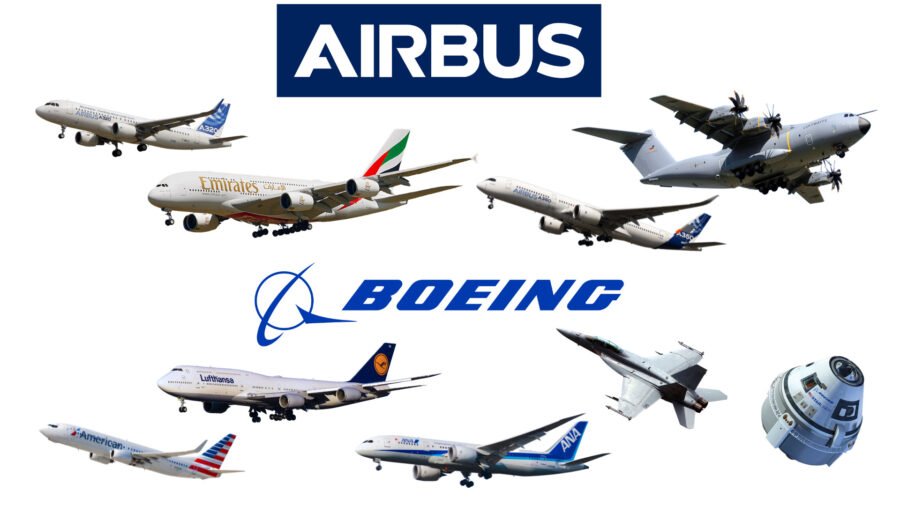
The rivalry between Airbus and Boeing, two aviation giants, has spanned over five decades, resulting in significant innovations in the commercial aircraft market. Both companies have focused on improving efficiency, increasing capacity, and advancing technology in their respective aircraft programs.
The Genesis of Airbus and Boeing
| Aspect | Boeing | Airbus |
|---|---|---|
| Date Founded | 1916 | December 18, 1970 |
| CEO | N/A | Guillaume Faury |
| Headquarters Location | Chicago, Illinois, USA | Toulouse, France |
| Stock Code | BA | AIR |
| Business Type | Planemaker | Planemaker |
| Key Products | Boeing 247, 707, 727, 737, 747 | Airbus A220, A320, A330, A340, A350, A380 |
Despite entering the industry years later, Airbus has established itself as a leading competitor to Boeing, originally dominating the market. Over time, Airbus has expanded its product line to match Boeing from narrowbodies to widebodies, and now together, they contribute a significant portion of the world’s commercial aircraft.
Deregulation and Its Impact
The deregulation of the late 1970s enabled more competition within the U.S. airline industry. As a result, there was a rising need for efficient short-haul aircraft, solidifying the Boeing 737’s position as a leading narrowbody jet. However, Airbus responded with the A320 in 1984, featuring innovative fly-by-wire controls and a side-stick controller, setting itself apart from Boeing concepts. Although skepticism initially hampered its acceptance, the A320 gained favor with American airlines.
Narrowbody Innovations: A320neo vs. 737 MAX
The introduction of the Airbus A320neo provided significant advantages, such as approximately 15% lower fuel consumption compared to its predecessors. The backlog for this family is extensive, with over 7,100 units. In comparison, the Boeing 737 MAX faces challenges related to safety flaws, leading to a global grounding in 2019, affecting its competitiveness.
Widebody Aircraft Dynamics
In terms of widebody aircraft, the competition has also been fierce. Although Airbus attempted to compete in this segment with the A330 and A340, it struggled against Boeing’s dominance, especially as trends shifted towards more efficient twin-engine designs.
| Specifications | Airbus A321neo | Boeing 737 MAX 8 |
|---|---|---|
| Overall Length | 146 feet (44.51 meters) | 129 feet 8 inches (39.52 meters) |
| Wingspan | 117 feet 5 inches (35.80 meters) | 117 feet 10 inches (35.9 meters) |
| Range | 4,700 nautical miles (8,700 kilometers) | 3,500 nautical miles (6,480 kilometers) |
| Max Takeoff Weight | 101 tonnes | 82.2 tonnes |
| Capacity | Up to 244 | Up to 178 (in two-class layout) |
Challenges and Future Prospects
Despite Airbus’s current edge over Boeing in the single-aisle market, both companies face ongoing production challenges. Airbus must address engine supply chain issues while Boeing continues to grapple with the aftermath of the 737 MAX problems. Meanwhile, new players like China’s Comac C919 are starting to enter the market, potentially disrupting the duopoly in the coming years.
The future of the Airbus-Boeing rivalry is poised to evolve, with continued technological advancements and geopolitical influences shaping the landscape of commercial aviation.