
European Aviation Growth in 2025
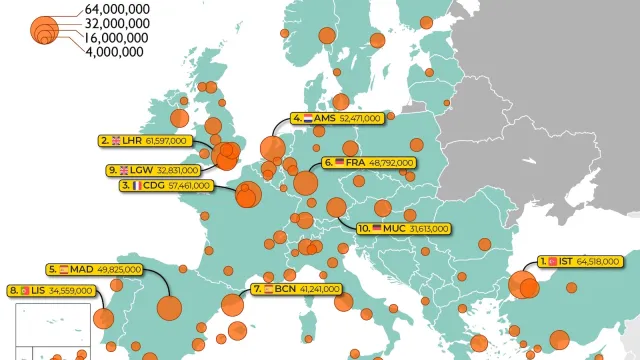
The European aviation sector continues to exhibit resilience and steady growth in 2025, driven by increasing passenger demand, expanded airline capacity, and growing international networks. According to Airports Council International (ACI), Europe managed over 2.4 billion passengers in 2024, reaching 98% of pre-pandemic traffic levels. This upward trajectory has persisted into 2025, with Europe’s major hubs closely competing for top spots in global rankings.
Istanbul Airport Takes the Lead
In September 2025, data from OAG highlights that Istanbul Airport (IST) has cemented its position as Europe’s busiest airport, overtaking traditional leaders like London Heathrow (LHR) and Paris Charles de Gaulle (CDG). Other key airports in Germany, Spain, Italy, and the Netherlands have also reported growth, showcasing a balanced distribution of capacity across the continent.
Istanbul Airport (IST)
- 4.48 million seats handled
- 5% increase in capacity year-on-year
- Strategically located as a bridge between Europe, Asia, and Africa
London Heathrow Airport (LHR)
- Ranks second with 4.4 million seats
- Capacity remains unchanged since September 2024
- Primary hub for British Airways and Virgin Atlantic
Paris Charles de Gaulle Airport (CDG)
- Third position with 3.72 million seats
- Main hub for Air France
Frankfurt International Airport (FRA)
- Fourth place with 3.71 million seats
- 3% increase in seat capacity year-on-year
- Primary hub for Lufthansa
Amsterdam Schiphol Airport (AMS)
- Fifth with 3.66 million seats
- 3% increase in capacity year-on-year
- Hub for KLM Royal Dutch Airlines
Comparison of Facilities
| Feature | Istanbul Airport (IST) | London Heathrow (LHR) | Paris Charles de Gaulle (CDG) | Frankfurt Airport (FRA) | Amsterdam Schiphol (AMS) |
|---|---|---|---|---|---|
| Runways | 5 planned (capacity for 6) | 2 | 4 | 4 | 6 |
| Terminals | 1 massive terminal | 4 passenger terminals | 3 main terminals | 2 main terminals (T3 under construction) | 1 terminal divided into 3 departure halls |
| Notable Strengths | Rapid growth, strong Europe–Asia connections, designed for future expansion | Strong transatlantic links, major international transfer hub | Major Europe–Africa connections, strong intercontinental network | Leading European cargo hub, intercontinental reach | Efficient single-terminal design, seamless connectivity |
Growth in Southern Europe
Southern European airports are also prominent in the rankings:
- Madrid Barajas (MAD): Sixth with 3.27 million seats, steady from 2024. Primary hub for Iberia.
- Barcelona El Prat (BCN): Seventh with 3.01 million seats. Noted for low-cost carriers.
- Rome Fiumicino (FCO): Eighth with 2.88 million seats. Major hub for ITA Airways.
Comparison of Major South European Airports – September 2025
| Feature | Madrid Barajas (MAD) | Barcelona El Prat (BCN) | Rome Fiumicino (FCO) |
|---|---|---|---|
| Runways | 4 | 3 | 4 |
| Terminals | 4 passenger terminals (T1–T4) | 2 passenger terminals (T1, T2) | 4 passenger terminals |
| Notable Strengths | Major Iberia hub, strong Europe–Latin America connectivity | Strong short-haul European network | Leading Italian gateway |
Rapid Growth at Munich and Sabiha Gokcen
- Munich (MUC): Ninth with 2.64 million seats (6% increase). Key hub for Lufthansa.
- Istanbul Sabiha Gokcen (SAW): Tenth with 2.53 million seats. Surged with a 23% increase.
10 Busiest Airports in Europe (September 2025)
| Rank | Airport Code | Airport Name | Seats (Total) | 2024 Rank |
|---|---|---|---|---|
| 1 | IST | Istanbul Airport | 4,475,991 | 2 |
| 2 | LHR | London Heathrow Apt | 4,400,075 | 1 |
| 3 | CDG | Paris Charles de Gaulle Apt | 3,723,165 | 3 |
| 4 | FRA | Frankfurt International Apt | 3,711,737 | 4 |
| 5 | AMS | Amsterdam Airport | 3,660,799 | 5 |
| 6 | MAD | Madrid Barajas Apt | 3,270,311 | 6 |
| 7 | BCN | Barcelona Apt | 3,015,558 | 7 |
| 8 | FCO | Rome Fiumicino Apt | 2,884,740 | 8 |
| 9 | MUC | Munich International Airport | 2,644,007 | 9 |
| 10 | SAW | Istanbul Sabiha Gokcen Apt | 2,533,350 | 13 |
The September 2025 data affirm that Europe’s aviation sector keeps evolving, with Istanbul Airport solidifying its leadership. London’s Heathrow and Paris’s Charles de Gaulle maintain their strong standings. Airports in Frankfurt and Amsterdam continue their steady growth, while those in Southern Europe like Madrid, Barcelona, and Rome maintain regional balance. Impressively, Istanbul Sabiha Gokcen and Munich are noted for the highest growth rates, indicating a shift in Europe’s aviation dynamics. With demand expected to rise, these top airports may experience further competition moving into 2026, notably between Istanbul and London for the number one ranking.