
Swedish Gripen Jets Intercept Russian Su-30s
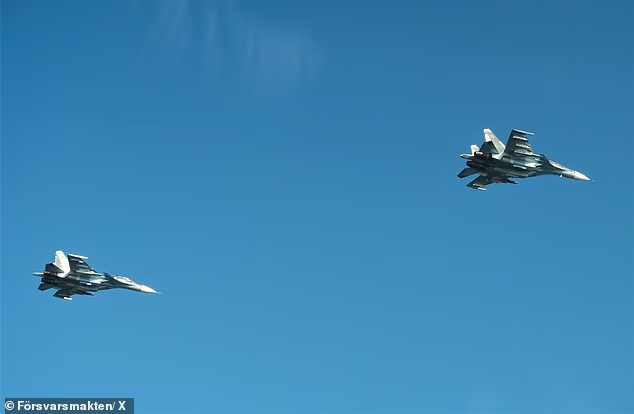
The Swedish Air Force has confirmed that its JAS-39 Gripen fighters successfully intercepted two Russian Su-30 aircraft over the Baltic Sea. These Russian jets were carrying KH-31 anti-radar missiles, a development deemed by officials and defense analysts as part of Moscow’s assertive military posture near NATO territories. Additionally, a Russian IL-20 intelligence aircraft was also intercepted.
The Interception Incident
According to reports, Swedish defense radars identified the presence of two Su-30s operating in international airspace, but unusually close to Sweden’s air defense perimeter. These aircraft were equipped with KH-31 missiles, designed for high-speed attacks on enemy radar and missile installations.
The Swedish Air Force responded promptly by dispatching two Gripen jets to visually identify and escort the Russian planes. The encounter concluded without any incident, and the Russian aircraft returned to their home airspace without breaching Swedish territory.
“Flygvapnets incidentberedskap genomförde under onsdagen insatser i internationellt luftrum över södra Östersjön. JAS 39 Gripen identifierade en rote ryska stridsflyg av typen SU-30. Därefter eskorterades ett ryskt spaningsflyg av typen IL- 20. Flygvapnet står alltid i beredskap.” — Försvarsmakten (@Forsvarsmakten), September 11, 2025
Strategic Context
This incident highlights the rising tensions in the Baltic region following Sweden’s accession to NATO in March 2024. Russia’s frequent air operations close to Alliance airspace, often conducted with inactive transponders, are regarded by NATO as both unsafe and provocative actions.
The inclusion of KH-31 missiles on the Russian aircraft elevates the seriousness of the encounter, suggesting a more assertive demonstration of Russia’s capabilities to strike NATO air defenses.
About the KH-31 Missile
The KH-31, also known as the AS-17 “Krypton” in NATO terms, is a supersonic missile that can reach speeds of up to Mach 3. It is available in variants designed for anti-radiation and anti-ship purposes, with a range of up to 110 kilometers (68 miles). Its use in border patrols is interpreted as a strategic message of deterrence and intimidation.
By Seb Mil
Seb Mil, with a distinguished career background in the French Air Force, is an expert journalist with AIRLIVE.net. He covers breaking military aviation news and offers insightful analyses in the domain of flight safety and general aviation.