
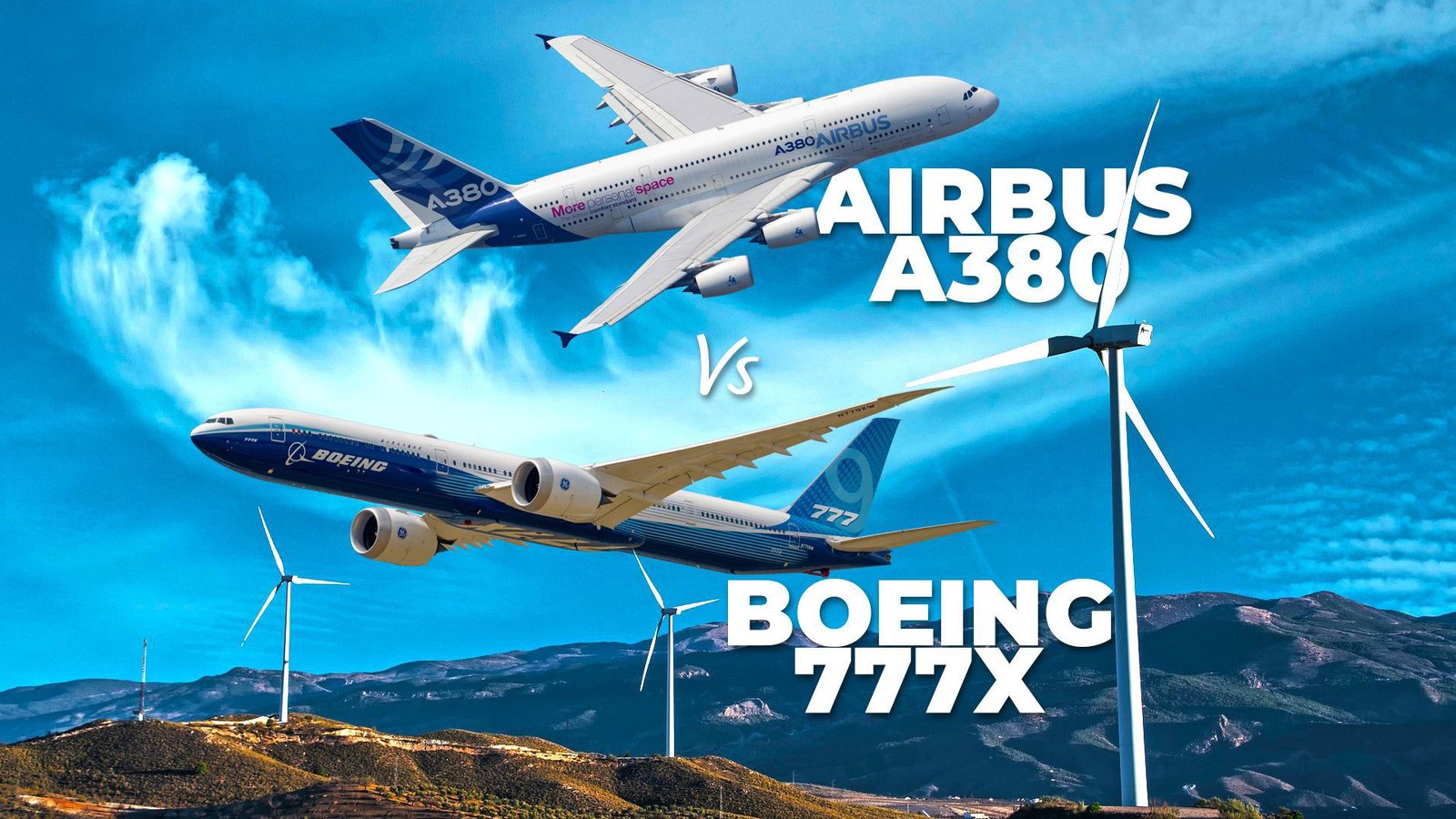
Airbus A380 vs. Boeing 777X: Size and Capacity
The Airbus A380, a double-deck behemoth, has been a significant player in long-haul travel since its introduction in the mid-2000s. Designed to accommodate more passengers than any other aircraft, it became a flagship model among major airlines. However, its dominance is waning as modern, more efficient twin-engine aircraft gain favor.
The Boeing 777X’s Role
Boeing’s latest widebody offering, the 777X, aims to fill some of the A380’s void. The 777X family includes the long-range 777-8, the 777-8F freighter, and the elongated 777-9. This series combines advanced technology with large capacity, nearly rivaling the superjumbo’s scale. Notably, the 777-9 will claim the title of the longest airliner upon its debut.
Physical Dimensions Comparison
The question of which aircraft is “bigger” varies depending on the metric used. The Boeing 777-9 is the longest airliner, measuring 251 feet 9 inches (76.73 m), while the Airbus A380 measures 238 feet 8 inches (72.73 m) in length. Despite the 777X’s length, the A380 surpasses it in other dimensions, notably in wingspan and height. The A380’s wings span 261 feet 8 inches (79.75 m), compared to the 777X’s 235 feet 5 inches (71.75 m), unfolded.
| Specification | Airbus A380-800 | Boeing 777-9 |
|---|---|---|
| Length | 238 feet 8 inches (72.73 meters) | 251 feet 9 inches (76.73 meters) |
| Wingspan | 261 feet 8 inches (79.75 meters) | 235 feet 5 inches (71.75 meters) unfolded, 212 feet 9 inches (64.84 meters) folded |
| Height | 79 feet (24.09 meters) | 64 feet 1 inch (19.53 meters) |
| Max. Takeoff Weight | 575 Tonnes | 351 Tonnes |
| Capacity | Up to 853 | Up to 475 |
| Engines | 4x Engine Alliance GP7200 or Rolls-Royce Trent 900 | 2x General Electric GE9X |
Purpose and Capability Differences
The A380’s design caters to transporting more passengers between major hubs, fulfilling routes with high travel demand. It often required specialized airport infrastructure. In contrast, the 777X balances size and efficiency, operating from standard airport gates due to its folding wingtips, and supporting airlines’ flexibility needs.
Changing Airline Priorities and Aircraft Adoption
The focus in aviation has shifted significantly. Initially, the drive was to transfer larger groups of passengers, emphasizing planes like the A380. Nowadays, efficiency and flexibility steer decisions, as evident in the expanded role of twin-engine jets like the 777X.
The A380, while once a marvel of engineering due to its immense capacity, has seen a decrease in usage. Airlines like Air France phased out the A380 during the pandemic. According to recent data, around 157 A380s are still active, with Emirates operating the largest fleet.
Airline Transition and Future Outlook
Airlines are increasingly turning to models like the Boeing 777X and Airbus A350 for their capacity and efficiency. The future of superjumbo jets is unlikely to witness new developments as airlines prioritize economic sustainability over sheer size. While the idea of a modernized A380 has emerged, the market dynamics and production costs make such an endeavor impractical.
Boeing has secured over 600 orders for the 777X across its variants, highlighting its replacement potential for the A380’s role without mirroring its size. In addition to the 777X, the market favors the A350 and 787 Dreamliner for their adaptability in diverse and competitive routes.